
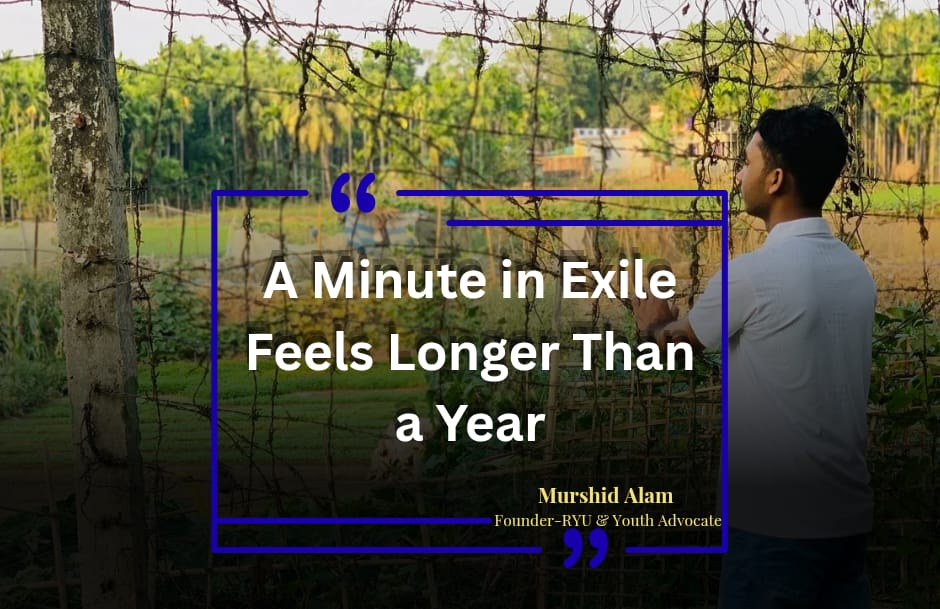
A minute in exile does not pass like a minute anywhere else. It stretches, weighs, and lingers. Each second carries memories of what was lost and the uncertainty of what lies ahead. Time, in exile, is not measured by clocks but by longing—by waiting for dignity, for safety, and for a place to belong.
I have lived through exile, where every day begins and ends with questions. Where will the next step lead? When will there be a solution? Will the world remember us beyond words, reports, and promises? These questions follow me, not as thoughts but as constant companions. In this space of uncertainty, even a single minute can feel heavier than an entire year.
Life in exile is defined by boundaries that are both physical and invisible. The chain fences that surround us are not just barriers of metal; they represent the limits placed on our freedom, movement, and opportunity. But beyond the fences, there are also invisible walls—of uncertainty, of restricted rights, and of a future that feels paused. Standing beside these fences, I often reflect on my past, on the journey that led me here, and on the hope that still keeps me moving forward.
Despite these hardships, hope has never left me. It comes in many forms—through humanitarian actors who continue to support us, through international voices that speak about our situation, and through the quiet resilience of our people. These efforts remind us that we are not forgotten. They give us strength to continue, to believe that change is possible. Yet, hope alone is not enough without action. While many actors have extended their support, a comprehensive and lasting solution is still missing.
The Rohingya crisis is not just a humanitarian issue; it is a question of justice, identity, and human dignity. It is about people who have been forced into exile, carrying the weight of history, displacement, and loss. We have waited for years—years filled with meetings, discussions, and commitments. But for those of us living this reality, waiting is not passive. It is a daily experience, filled with endurance and resilience.
In exile, time behaves differently. A single day can feel endless, filled with repetition and reflection. A month can pass without visible change, yet each moment leaves its mark. And a year—what is a year in exile? It is not just twelve months; it is a collection of hopes raised and hopes delayed. It is survival, adaptation, and the quiet determination to keep going despite uncertainty.
My journey is not unique. It reflects the experiences of many others who share this reality. We are people with dreams, skills, and ambitions. We are youth, leaders, students, and contributors to our communities. Yet, our potential remains constrained by circumstances beyond our control. What we seek is not charity, but justice. Not temporary relief alone, but a permanent solution that allows us to live with dignity and security.
I have witnessed the engagement of humanitarian and international actors who work tirelessly to support us. Their efforts have made a difference in our daily lives, offering assistance, protection, and advocacy. I am grateful for their commitment. However, the ultimate goal must go beyond support—it must lead to resolution. Without a political solution, exile continues to define our existence.
As I stand and look beyond the chain fences, I do not see only confinement. I also see resilience. I see a generation that refuses to give up. I see young people who continue to learn, to organize, and to raise their voices. I see hope that persists even in the most difficult conditions. This hope is what gives meaning to each passing minute.
But hope must be matched with responsibility. The international community, regional actors, and relevant stakeholders must work together to find a solution rooted in dialogue, justice, and accountability. A solution that addresses the root causes of displacement and ensures that no one is forced to live their life in exile again.
For those who read this, I ask you to see beyond statistics and headlines. See the human lives behind them. See the minutes that feel like years. See the dreams that continue to exist despite hardship. And most importantly, see the urgency of action.
Because for us, time is not just passing—it is waiting.
And every minute in exile truly feels longer than a year.